Reading Comprehension — 4th Grade Lesson
Students will make inferences, identify text structure (cause/effect, compare/contrast, sequence), and compare ideas across texts.
4th Grade · Reading Comprehension · ~25 min lesson
Deeper thinking: inference
In 4th grade, readers move from what the text says to what the text means. An inference is a conclusion you reach by combining text clues with what you already know — reading between the lines.
Example: “The ground was wet and puddles formed in the driveway.” Inference: it had rained recently. (Clue: wet ground + puddles. Knowledge: rain makes puddles.)
The inference formula
Text clue + What I know = Inference
- Find a clue in the text.
- Connect it to what you already know.
- State your conclusion.
Text structures in nonfiction
Nonfiction is organized in patterns. Learn the signal words:
| Structure | What it does | Signal words |
|---|---|---|
| Sequence | order of steps/events | first, then, finally |
| Cause & effect | reason → result | because, so, therefore |
| Compare & contrast | similarities/differences | like, unlike, whereas, both |
| Description | explains a topic | for example, such as |
Comparing across texts
Readers also compare ideas between two passages. Ask: What does each text say? What’s the same? What’s different? Writers organize these comparisons with compare/contrast language.
The 4th grade routine
- First read: grasp the topic and main idea.
- Second read: look for structure signal words.
- For each question, decide: stated fact or inference?
- Support every answer with the text.
Practice with the exercises above, then try these free printable passages:
Practice Exercises
Try these on your own, then reveal the answer to check.
Passage: 'The ground was wet and puddles formed in the driveway.' What can you infer about the weather?
💡 Inference = clues in the text + what you already know.
Passage: 'First, the seeds are soaked. Then they are pressed into the tray. Finally, they are covered with soil.' What text structure is this?
💡 Look for order words.
Compare these two sentences: 'Owls hunt at night.' 'Hawks hunt during the day.' What text structure?
💡 It points out a difference between two things.
What is the difference between a fact you read and an inference you make?
💡 Think 'reading between the lines.'
Signal words like 'because' and 'as a result' point to which structure?
💡 They connect a reason to an outcome.
Printable Worksheets
Put this lesson into practice with free, printable worksheets — each with an answer key.
Before You Start
- 3rd grade comprehension skills (evidence, cause/effect)
- Fluent reading of grade-level texts
Common Mistakes to Watch For
- Confusing an inference (reading between the lines) with something directly stated
- Missing structural signal words in nonfiction
What to Learn Next
Browse more Reading Comprehension worksheets or explore all 4th Grade worksheets.
Related Worksheets
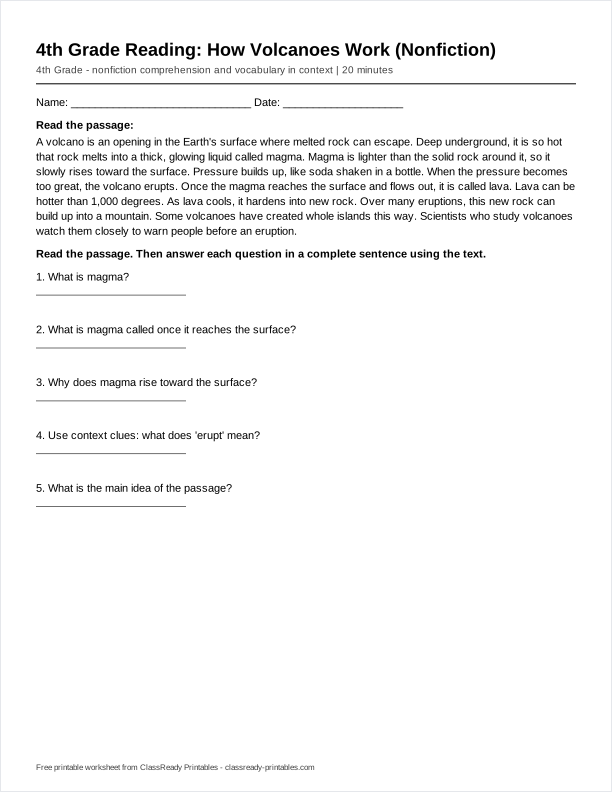
4th Grade Reading: How Volcanoes Work (Nonfiction)
Read an informational passage about volcanoes and answer main-idea, detail, and vocabulary questions.
Frequently Asked Questions
What exactly is an inference?
An inference is a conclusion you reach by combining clues in the text with your own knowledge. The author doesn't say it directly — you figure it out.
Why does text structure matter?
Recognizing structure (sequence, compare/contrast, cause/effect, description) helps readers organize information and predict how the text will flow.
Original & reviewed. Every worksheet is created in-house from a grade-level skill brief, checked for a correct answer key, and reviewed for grade-appropriateness. Our editorial policy.