Factors and Multiples — 4th Grade Lesson
Students will find factor pairs, list multiples, and identify prime and composite numbers to 100.
4th Grade · Factors & Multiples · ~25 min lesson
What are factors?
Factors are numbers that divide another number evenly. Factors of 12 are all the numbers that divide 12 with no remainder.
Factors of 12: 1, 2, 3, 4, 6, 12
Find them in factor pairs (two numbers that multiply to 12):
1 × 12, 2 × 6, 3 × 4
What are multiples?
Multiples are what you get when you multiply a number by whole numbers.
Multiples of 5: 5, 10, 15, 20, 25, …
Prime numbers
A prime number has exactly two factors: 1 and itself.
2, 3, 5, 7, 11, 13, 17, 19
(2 is the only even prime.)
Composite numbers
A composite number has more than two factors.
4, 6, 8, 9, 10, 12, 14, 15, …
The number 1
1 is neither prime nor composite — it has only one factor (itself).
How to find all the factors
- Start at 1 and work up.
- List each factor pair (1 × n, 2 × …, 3 × …).
- Stop when the pairs start repeating.
12: 1×12, 2×6, 3×4 → done!
Why it matters
Factors and multiples are the building blocks for simplifying fractions, finding common denominators, and understanding divisibility — the foundation of middle-school math.
How to practice at home
- Factor pairs: “What times what equals 24?” (list every pair)
- Multiple count: skip count to list multiples.
- Prime detective: check whether numbers to 50 are prime or composite.
- Real splits: “Can 18 cookies be split evenly among 3 friends? Among 5?”
Practice with the exercises above, then download these free printable worksheets:
Practice Exercises
Try these on your own, then reveal the answer to check.
List all the factors of 12.
💡 All numbers that divide 12 evenly.
Is 2 a prime number?
💡 It has exactly two factors: 1 and 2.
Is 15 prime or composite?
💡 It has more than two factors: 1, 3, 5, 15.
List the first three multiples of 5.
💡 5 × 1, 5 × 2, 5 × 3.
Which number is a factor of both 8 and 12?
💡 Both divide evenly by 2 and 4.
Is 9 prime or composite?
💡 Its factors are 1, 3, and 9.
Printable Worksheets
Put this lesson into practice with free, printable worksheets — each with an answer key.
Before You Start
- Multiplication facts
- Division basics
Common Mistakes to Watch For
- Thinking 1 is a prime number (it is neither prime nor composite)
- Forgetting the factor pairs of a number include 1 and itself
What to Learn Next
Browse more Factors & Multiples worksheets or explore all 4th Grade worksheets.
Related Worksheets
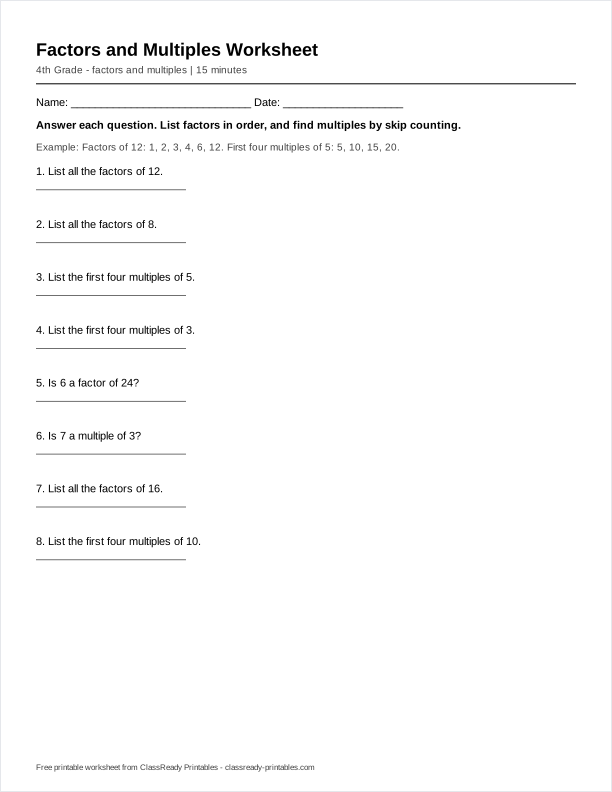
Factors and Multiples Worksheet
List factors, list multiples, and learn to tell these two ideas apart.
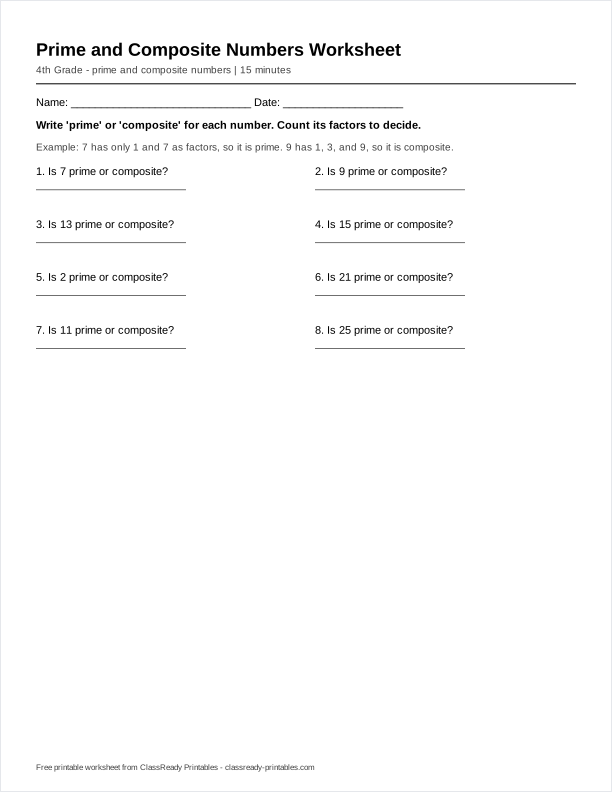
Prime and Composite Numbers Worksheet
Tell whether each number is prime (exactly two factors) or composite (more than two).
Frequently Asked Questions
What is the difference between a factor and a multiple?
A factor divides a number evenly (4 is a factor of 12). A multiple is what you get when you multiply (12, 24, 36 are multiples of 12). Factors are smaller or equal; multiples are larger or equal.
What are prime and composite numbers?
A prime number has exactly two factors: 1 and itself (2, 3, 5, 7, 11). A composite number has more than two factors (4, 6, 8, 9). The number 1 is neither.
Original & reviewed. Every worksheet is created in-house from a grade-level skill brief, checked for a correct answer key, and reviewed for grade-appropriateness. Our editorial policy.