Reading Comprehension — 5th Grade Lesson
Students will summarize a text in their own words, identify the theme, analyze point of view, and compare how authors present ideas.
5th Grade · Reading Comprehension · ~25 min lesson
Summarizing like a pro
A summary is a short retelling of the key events — beginning, middle, and end — in your own words. Leave out minor details. If you can say it in 30 seconds, you’ve got it.
Good summary: “Leo trained hard through many setbacks, and although he didn’t win the race, he finished proud of his effort.”
Topic vs. theme
- Topic = the subject (a boy training for a race).
- Theme = the message or life lesson (perseverance pays off).
To find the theme, ask: “What lesson does the character learn?” and “What does the story mean beyond what happens?”
Point of view
- First person — the narrator says “I”: readers see only that character’s thoughts.
- Third person limited — the narrator follows one character’s thoughts.
- Third person omniscient — the narrator knows everyone’s thoughts.
Point of view controls what readers know, so it shapes the whole story.
Comparing texts
5th graders compare how two authors handle the same topic or theme: the words they choose, the facts they include, and the message they push. Ask: What’s the same? What’s different? Why?
The 5th grade routine
- First read: get the gist.
- Identify topic vs. theme.
- Summarize in your own words (short!).
- Note the point of view and what it reveals or hides.
- When comparing, list similarities and differences.
Practice with the exercises above, then try these free printable passages:
Practice Exercises
Try these on your own, then reveal the answer to check.
Passage: 'For weeks, Leo trained for the race. He fell, got up, and kept going. On race day he finished — not first, but proud.' What is the theme?
💡 The theme is a life lesson, not just what happens.
Is 'a boy trains for a race' the topic or the theme?
💡 Topics are subjects; themes are lessons about life.
A story told from 'I' perspective uses which point of view?
💡 Think: the narrator says 'I'.
How does first-person point of view affect what readers know?
💡 The narrator is inside the story.
What is the difference between a summary and the theme?
💡 Summary = what happens. Theme = what it means.
Printable Worksheets
Put this lesson into practice with free, printable worksheets — each with an answer key.
Before You Start
- 4th grade comprehension skills (inference, text structure)
- Independent reading stamina
Common Mistakes to Watch For
- Summarizing with too many details (a summary ≠ retelling everything)
- Confusing the topic with the theme
What to Learn Next
Browse more Reading Comprehension worksheets or explore all 5th Grade worksheets.
Related Worksheets
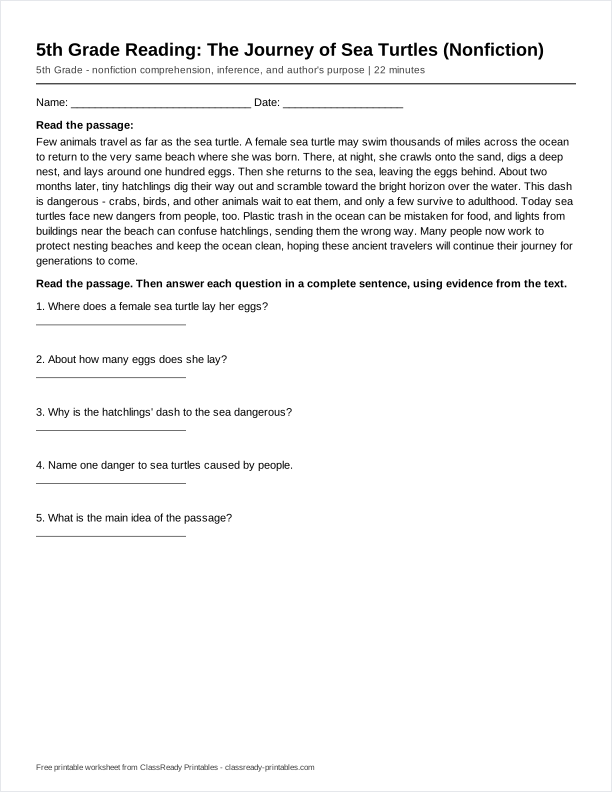
5th Grade Reading: The Journey of Sea Turtles (Nonfiction)
Read an informational passage about sea turtles and answer main-idea, inference, and author's-purpose questions.
Frequently Asked Questions
What is a good summary length for 5th grade?
A few sentences that cover the beginning, middle, and end without retelling every detail. One rule: a summary is short enough to say out loud in 30 seconds.
How do you find the theme?
Ask 'what lesson does the character learn?' or 'what is this story really about?' The theme is the message that applies beyond the story.
Original & reviewed. Every worksheet is created in-house from a grade-level skill brief, checked for a correct answer key, and reviewed for grade-appropriateness. Our editorial policy.